

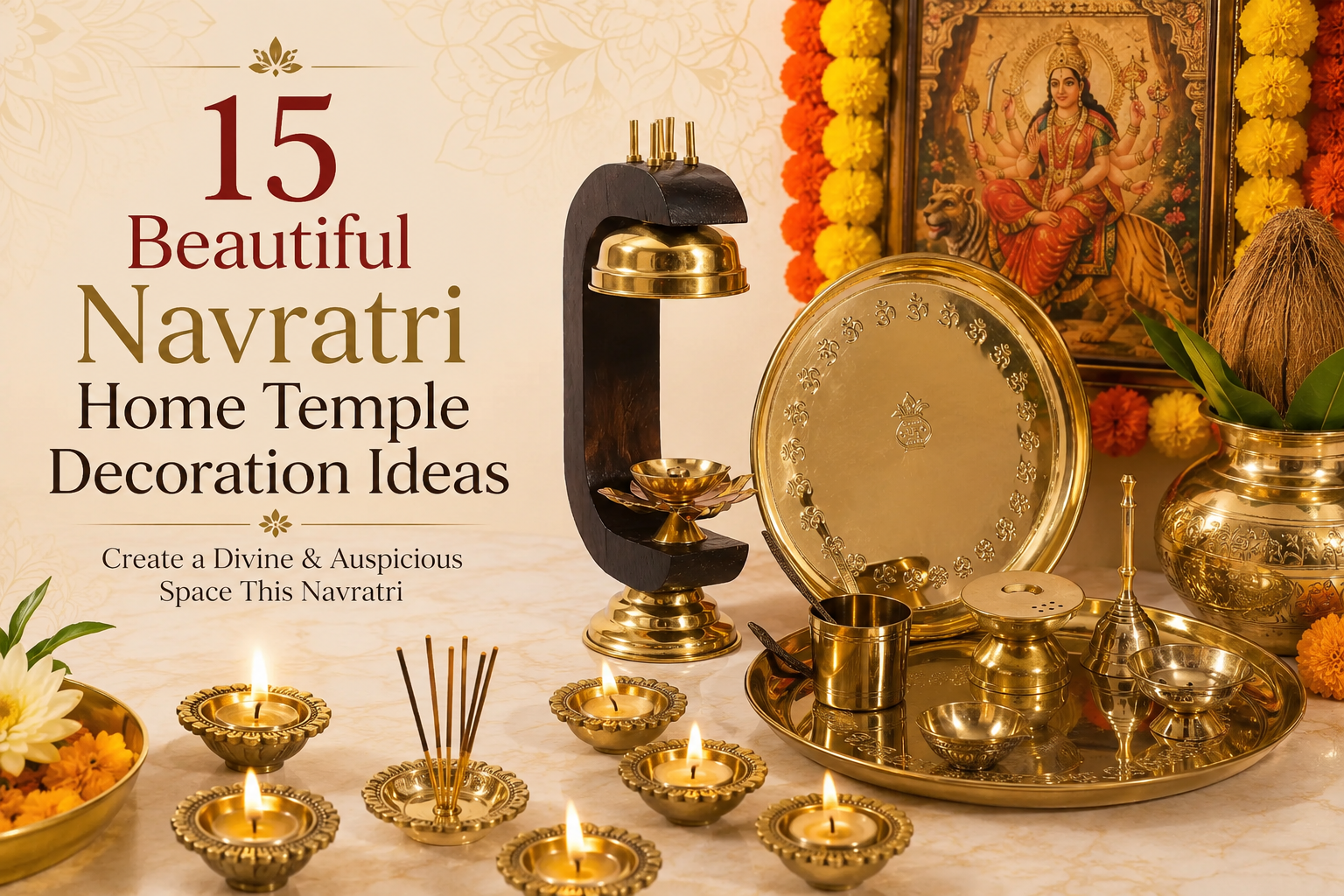
15 Beautiful Navratri Home Temple Decoration Ideas
Navratri is the one time of year when even a small mandir corner deserves real attention. Nine nights, nine forms of the goddess, and a lot of families quietly competing to see whose home temple looks the best for the evening aarti. If you're staring at your pooja space right now wondering where to start, here are 15 ideas that actually work — most of them built around brass décor you can keep using long after the festival ends.
1. Light up the mandir with brass diyas
Nothing changes the mood of a pooja room faster than diyas. A single lamp looks lonely; five or six arranged around the deity look like a proper celebration. Brass holds heat evenly and doesn't blacken the way cheaper metal does, so they still look good on day nine.
Try: a set of six heavyweight brass diyas, a Kamakshi diya, a brass shankha diya, or a brass tortoise diya for variety in shape and height.
2. Add a hanging diya for an instant temple character
There's a reason temples hang their lamps instead of only placing them on the floor — it draws the eye upward and makes the whole space feel taller. A brass hanging diya with small bells does this in one move, and the soft jingle when it swings is oddly calming.
3. Put together a complete puja thali
Half the stress during Navratri mornings comes from hunting for the diya, the kumkum, the bell, all scattered in different drawers. A proper brass puja thali set keeps everything in one place and looks intentional rather than thrown together.
Try: a complete brass puja thali set, or a steel-and-brass combination if you want something lower maintenance.
4. Make the kalash your centerpiece
Kalash Sthapana kicks off the nine days, and the kalash itself deserves to be seen, not tucked behind everything else. An ornate brass kalash or lota placed front and center gives the whole altar a focal point.
5. Keep the air fragrant with an agarbatti holder
Incense during morning and evening prayers is non-negotiable in most homes, but loose ash everywhere is not a good look. A brass agarbatti stand, or a wood-and-brass dhoop holder, contains the mess and looks intentional, sitting next to the idols.
6. Bring in a temple bell
I don't think Navratri aarti sounds complete without a bell. A brass Nandi puja bell adds that layer of sound that somehow makes the whole ritual feel more grounded.
7. Set up a dedicated Durga corner
If your mandir has the space, carve out a section specifically for Maa Durga — idol, diyas, fresh flowers, and a kalash grouped together rather than spread across the whole shelf. Grouping matters more than most people realize; it's what makes an altar photograph well and, more importantly, feel like a real shrine instead of a collection of objects.
8. Add sacred symbols like the trishul
A trishul on a small stand next to the goddess adds both symbolism and visual height, since most Navratri décor tends to stay low and flat otherwise.
9. Swap plastic décor for brass, permanently
Plastic garlands and lights have their place, but they go straight in the bin after the festival. Brass diyas, bells, kalash, and incense holders come out every year — Navratri, Diwali, Karva Chauth, whatever's next. It pays for itself over two or three festivals.
10. Go minimalist with a modern mandir setup
Not every home wants a heavily layered, maximalist altar. If yours leans more contemporary, a wood-and-brass all-in-one puja stand gives you clean lines without losing the traditional feel entirely.
11. Organize the small stuff properly
Sindoor, kumkum, and akshat look messy loose in a bowl. A matki-style sindoor dibbi keeps things tidy and, honestly, makes the whole altar look more put-together than people expect from something this small.
12. Include a water vessel for daily rituals
A traditional brass kamandal isn't just for Navratri — it's part of daily worship too, and having one on hand rounds out the altar setup properly.
13. Go for a golden glow with layered diyas
Instead of one oversized lamp, arrange several diyas of different heights symmetrically around the deity. Kamakshi diyas paired with heavyweight brass diyas and a hanging diya create depth that a single light source can't match.
14. Choose décor that outlasts the festival
This is worth repeating: brass thalis, kalash, bells, and diyas aren't single-use. They move straight into Diwali decorating, housewarming ceremonies, and everyday prayer once Navratri wraps up.
15. Bring it all together as one coordinated set
The homes with the best-looking mandirs during Navratri usually aren't spending more — they're just using matching pieces instead of a random mix. Diyas, thali, kalash, bell, agarbatti stand, hanging diya, trishul, kamandal, all in brass, all sitting together, tends to look far more finished than anything picked up piece by piece over the years.
FAQs
Q1. What are the best items to decorate a home temple for Navratri?
A: Diyas, a puja thali, a kalash, an incense holder, and a bell cover the essentials. Brass versions of these last well beyond the nine days, so they're not a one-time festival expense.
Q2. How do I set up a kalash for Navratri at home?
A: Place the kalash at the center of your mandir, ideally on a small raised platform or plate, with the goddess idol positioned just behind or beside it. Most households do this on the first day, as part of Kalash Sthapana.
Q3. Is brass décor better than plastic for Navratri decoration?
A: For anything you'll reuse — diyas, bells, kalash, thalis — yes. Brass doesn't crack, fade, or need replacing every year, and it works for Diwali, housewarming ceremonies, and daily puja too, not just Navratri.
Q4. How many diyas should I use for Navratri decoration?
A: There's no fixed number, but five or six arranged around the deity look fuller than one large lamp on its own. Mixing heights — a couple of tall Kamakshi diyas with smaller ones — adds more visual depth.
Q5. How can I decorate a small home mandir for Navratri without overcrowding it?
A: Stick to a few coordinated pieces instead of layering everything you own. A hanging diya, one thali, and a kalash are usually enough for a compact space — a minimalist wood-and-brass stand also helps if the shelf itself is small.
Q6. What is the significance of a bell in home temple worship?
A: The bell is typically rung at the start of aarti to mark the beginning of worship. Many households believe the sound helps settle the mind before prayer, which is part of why it's kept close to the main altar rather than off to the side.
Q7. Can I use the same Navratri décor for Diwali later?
A: Yes — that's one of the main reasons to invest in brass pieces over disposable ones. Diyas, bells, kalash, and thalis move straight from Navratri into Diwali and Lakshmi Puja without needing anything new.