

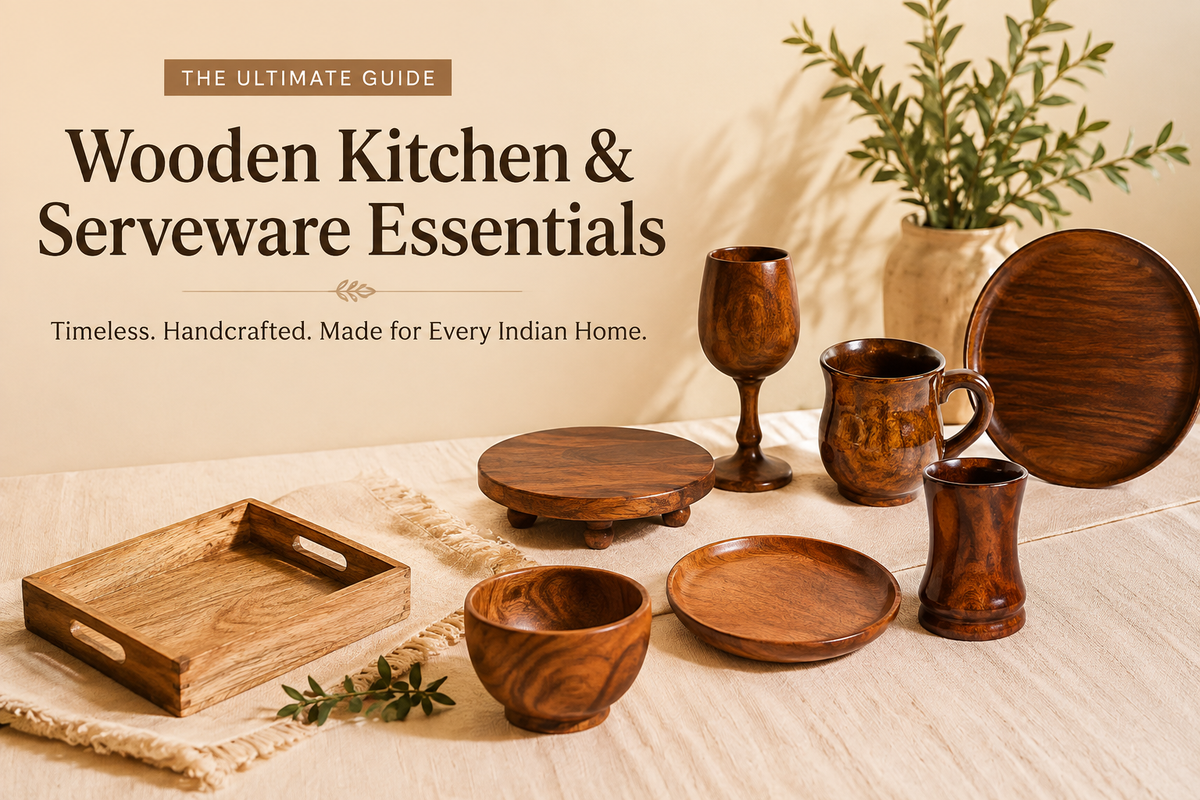
Complete Guide to Wooden Kitchenware: Best Wooden Tools & Essentials for Indian Kitchens
Your grandmother's belan and chakla are probably still around somewhere. Wood never really left Indian kitchens. What's changed is why people reach for it. Plastic ladles crack, non-stick spatulas melt at the edges after a year of daily tempering, and a lot of people are just going back to what worked in the first place.
This gets into what counts as wooden kitchenware, why it's worth switching, which pieces to buy first, and how to keep them from drying out or cracking on you.
What Is Wooden Kitchenware?
Wooden kitchenware is just kitchen tools made mostly of wood instead of steel, plastic, or silicone. Spatulas and spoons on the small end, chopping boards, trays, and bowls on the bigger end.
Most pieces come from a single block of hardwood, or a few pieces joined together — not molded the way plastic is. Sheesham, neem, acacia, teak, mango: pick any one and it'll behave a little differently. Mango dents more easily than acacia. Teak barely reacts to water. Neem's grain is a bit rougher. It's less "one wood fits all" than people assume.
Why Choose Wooden Kitchenware for Your Indian Kitchen?
1. It won't leach anything into your food
Cheap plastic and worn-out non-stick coatings can leach chemicals, especially with heat and acidic food. Wood doesn't have that problem; tamarind, lemon, tomato gravies - whatever you throw at it, it stays inert.
2. It won't scratch your pans
Metal spoons chew up non-stick coatings over years of use. A wooden spatula or ladle won't - soft enough to leave your kadhai alone, sturdy enough to handle thick dal or halwa without bending.
3. It's naturally cleaner than you'd expect
Certain hardwoods have antimicrobial properties - this isn't folk wisdom; it's been studied. The catch is you have to actually dry them after washing. Leave a wet wooden spoon in the sink, and you've undone the advantage.
4. The handle doesn't get hot
Wood barely conducts heat. Stir something on a high flame for ten minutes, and the handle stays cool. Small thing, but it matters when you're at the stove a while.
5. It's biodegradable; plastic isn't
Not much else to say here - wood breaks down; plastic doesn't. Swapping a few plastic tools for wooden ones is a low-effort way to cut down on waste.
6. It looks better on a table
This one's just aesthetics. A wooden bowl or tray has a warmth that steel and plastic don't - it's part of why more people are using wooden pieces for serving, not just cooking.
Essential Wooden Kitchenware Every Indian Kitchen Needs
Consider this your starter list for a full set of wooden essentials. Each piece does a specific job, and which one you buy matters more than people usually think.
1. Wooden Spatulas

Probably the most-used tool in an Indian kitchen. Tempering, sautéing onions, stirring thick gravy - it's in contact with a hot pan constantly, so it needs to hold up without scratching non-stick or steel. Look for a flat, slightly angled edge that can scrape the base of a kadhai, and a handle long enough to keep your hand off the heat. Sheesham and acacia take daily high-heat use well without splitting. A decent set has three: flat for sabzi, slotted for frying, and a corner spatula for the edges of the kadhai — the spot most tools miss.
2. Chopping Boards

Hardwood outlasts plastic, and it's kinder to your knives - the wood has enough give that it doesn't dull the blade as fast. It's also cleaner than people expect, since the tight grain doesn't let bacteria sit around the way scratched-up plastic does. That only holds if you dry it properly after washing, though. Two boards are a good baseline — one for veg, one for meat — and go for at least 1.5–2 inches thick if you're chopping on it daily, or it'll warp.
3. Roti Accessories (Belan & Chakla)

Steel and marble rolling pins exist, but most home cooks still reach for wood. It grips the dough a bit better, doesn't go cold in your hand, and is lighter - which you notice by roti number eight or nine. A good belan is smooth with no rough patches that'll tear the dough, and a chakla with a slightly raised edge keeps the flour from going everywhere.
4. Serving Trays

Works for a quick tea in the afternoon and just as well for a Diwali spread. A decent tray usually just stays out on the counter rather than getting put away; it looks fine sitting there. Raised edges or built-in handles help if you're carrying more than one cup at a time, and an oiled or matte finish ages better than a glossy one.
5. Wooden Bowls

Wooden bowls have a warmth on the table that steel and ceramic don't. Good for salads, dry fruits, namkeen, or just prepping batter on the counter. They're light, and unlike ceramic, they don't chip if a kid drops one. Keep a couple of small ones for nuts or pickle, and a bigger one or two for salad and mixing.
That's most of what a kitchen actually needs. Nothing fancy — just the stuff that gets used every day.
How to Choose the Right Wooden Kitchenware
A few things separate a piece that lasts years from one that cracks within months.
-
Wood type: Sheesham and acacia are dense; they'll take a beating. Mango wood is lighter and cheaper, but softer too. Teak costs more and barely reacts to water — worth it if you're buying something you'll use daily.
-
Finish: Food-safe oil - mineral oil, beeswax - not synthetic lacquer, especially on anything that actually touches food. Lacquer looks fine on a shelf and starts flaking the moment it meets a hot pan.
-
Craftsmanship: Run your hand over the edges. Smooth, no cracks, even grain. Hand-finished pieces cost more, but they age better than the machine-stamped stuff — you can usually tell just by looking at the grain.
-
Design that matches the job: A spatula for dal shouldn't look like one for parathas. If a tool is shaped for nothing in particular, it's usually not great at anything in particular either.
If you'd rather skip the trial and error, our Timber Luxe collection is built around exactly this - premium hardwood, food-safe finishes, shapes made for how Indian kitchens actually cook.
How to Care for Wooden Kitchenware
Take care of wood, and it'll outlast most things in your kitchen.
- Skip the dishwasher: Water plus heat for that long warps and cracks wood — always hand wash.
- Dry it right away: Standing water is the real enemy here, not the washing itself. Wipe it down and let it air out before you put it away.
- Oil it now and then: Every few weeks, rub a bit of food-grade mineral oil into boards, bowls, and spoons. Keeps them from drying out and splitting.
- Keep it away from heat and sun: Not next to the stove flame, not sitting in direct sun for hours. Both speed up cracking.
- Sand, don't scrub: Got a stubborn stain on a board? Light sanding with fine-grit paper works better than scrubbing at it.
Do this, and a wooden spoon or board will run you 5–10 years, easy - longer than most plastic or non-stick you'll buy in that time.
Wooden Kitchenware vs Plastic and Steel: A Quick Comparison
|
Feature |
Wooden Kitchenware |
Plastic |
Steel |
|
Chemical safety |
Naturally inert |
Can leach chemicals when heated/scratched |
Safe, but can react with acidic food if low grade |
|
Cookware protection |
Gentle, non-scratching |
Gentle, but degrades with heat |
Can scratch non-stick surfaces |
|
Heat handling |
Doesn't conduct heat |
Can warp/melt |
Conducts heat, gets hot to the touch |
|
Sustainability |
Biodegradable, renewable |
Non-biodegradable |
Recyclable but energy-intensive to produce |
|
Lifespan (with care) |
5–10+ years |
1–3 years |
Very long, but loses non-stick protection value |
|
Aesthetic |
Warm, natural |
Utilitarian |
Clean, industrial |
Frequently Asked Questions
Q1. Is wooden kitchenware safe for daily cooking?
A: Yes. Good quality hardwood with a food-safe finish is completely safe for daily use, including with hot food and acidic ingredients.
Q2. Which wood is best for Indian kitchens?
A: Sheesham and acacia are popular for their durability and resistance to daily wear, while mango wood offers a lighter, more budget-friendly option.
Q3. How often should I oil my wooden kitchenware?
A: Roughly once every 2–4 weeks for frequently used items like chopping boards, and less often for occasionally used pieces like serving trays.
Q4. Can wooden kitchenware go in the dishwasher?
A: No. Always hand-wash and dry immediately to prevent warping and cracking.